


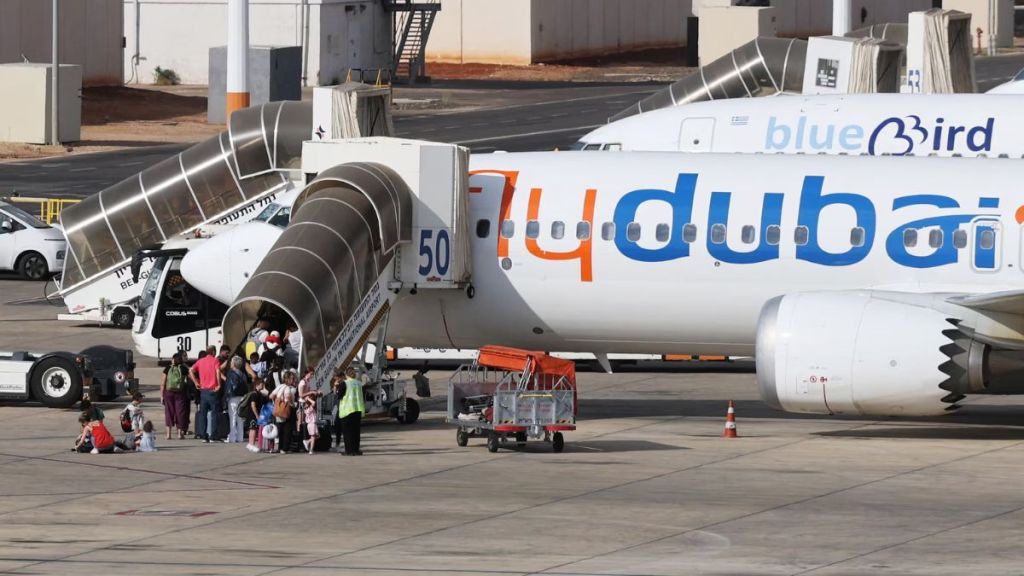

It was supposed to be a routine morning flight from Dubai to Tel Aviv. Flydubai flight FZ1073, operated by a Boeing 737 MAX 8 and piloted by Indian captain Smit Machchhar, took off from Dubai International Airport at 3.05 am UTC, or 8.35 am IST.
But the flight soon turned into an extraordinary emergency.
During the 3 hours and 55 minutes flight time, the aircraft suffered a dramatic loss of altitude, an altercation broke out in the cockpit and the plane transmitted both an emergency and a hijack-related transponder code, The Indian Express reported. Israeli fighter jets were reportedly scrambled as the aircraft headed towards Tel Aviv.
The plane eventually diverted to Tabuk in Saudi Arabia and landed safely. The roughly 170 passengers were later flown to their destination on another aircraft, while Machchhar and his Omani co-pilot, who reports claim was trying to seize control of the plane to crash it, were taken to hospital.
Machchhar has since been praised for helping bring the aircraft under control. Israeli officials have described the episode as an apparent terror attack, while flydubai has said that the motive remains unknown.
What is known about the flight’s emergency
At 5.21 am UTC, FZ1073 experienced a sharp drop in altitude. Al Jazeera reported that the aircraft descended more than 14,000 feet in less than 30 seconds, while CNN reported a fall of more than 17,400 feet in under two minutes.
At 5.31 am UTC, the aircraft reportedly transmitted squawk 7700, the internationally recognised code for a general emergency.
Seven minutes later, the transponder changed to 7500, the code used to indicate hijacking or unlawful interference.
When an aircraft transmits 7500, air traffic controllers attempt to establish contact with the crew and confirm that the emergency signal has been received. The aircraft is also given priority through the surrounding airspace, with other traffic kept clear of its route.
Military authorities can also become involved when a suspected hijacking is reported. In this case, Israeli fighter aircraft were reportedly scrambled to monitor the flight.
The aircraft later reverted to squawk 7700, but what happened in those intervening minutes became the central question.
What happened inside the cockpit?
Flydubai has confirmed that there was an altercation in the cockpit. Passenger accounts and mobile phone footage described panic in the cabin, with passengers moving towards the front of the aircraft.
Machchhar was seen injured and lying on the floor. Another passenger was also shown with a head injury.
Reports have described the incident as an attack on the captain, with stabbing cited as the best-supported description from the available accounts.
There has also been confusion over how the cockpit was accessed. One early version suggested that a passenger had kicked the cockpit door open. Modern cockpit doors, however, are specifically designed to withstand attempts at forced entry and cannot ordinarily be easily broken down.
According to Reuters, an Israeli government spokesperson said Machchhar, while injured, activated the cockpit door release, allowing a passenger and a crew member to enter.
Passenger Yaniv Hayoun later told Israeli Prime Minister Benjamin Netanyahu that he put the co-pilot in a chokehold and dragged him away from the cockpit. He also said he took control of the aircraft’s controls after the struggle.
Another passenger, Dr Shota Musaev, a dentist, told CNN that he helped restrain the attacker using headphone cords and plastic zip ties before tending to the injured pilot.
Israeli officials also said additional pilots were travelling on the aircraft and were scheduled to replace the original crew. Once the co-pilot had been subdued, those pilots reportedly helped regain control of the flight and complete the diversion to Tabuk.
Three descriptions, but one unanswered question
The incident has been described in several different ways, and the distinction matters.
A physical attack on the captain is supported by passenger accounts, footage and statements from Israeli officials. The 7500 signal indicates that unlawful interference was reported, but the transponder code itself does not establish who activated it or what motivated the action.
Israeli Defence Minister Israel Katz called it an “attempted jihadist terrorist attack”.
Prime Minister Benjamin Netanyahu said the pilot had tried to crash the aircraft with everyone on board. He also said it was too early to comment on any possible connection to Iran.
Flydubai has not endorsed that description. The airline has said the motives behind the incident remain unknown and are subject to a formal investigation.
The UAE will lead the investigation into the episode. Investigators will now have to establish what happened in the cockpit, why the aircraft entered a steep descent, who activated the 7500 signal and whether the incident was an attempted hijacking, a personal attack or something more deliberate.
For now, the broad picture is clear: a flight from Dubai to Tel Aviv suffered a major in-flight emergency, the captain was injured during a cockpit confrontation, passengers and crew intervened, and the aircraft was eventually brought safely to the ground in Saudi Arabia.
The motive behind the incident remains the biggest unanswered question, and that is what the UAE-led investigation will now seek to establish.