


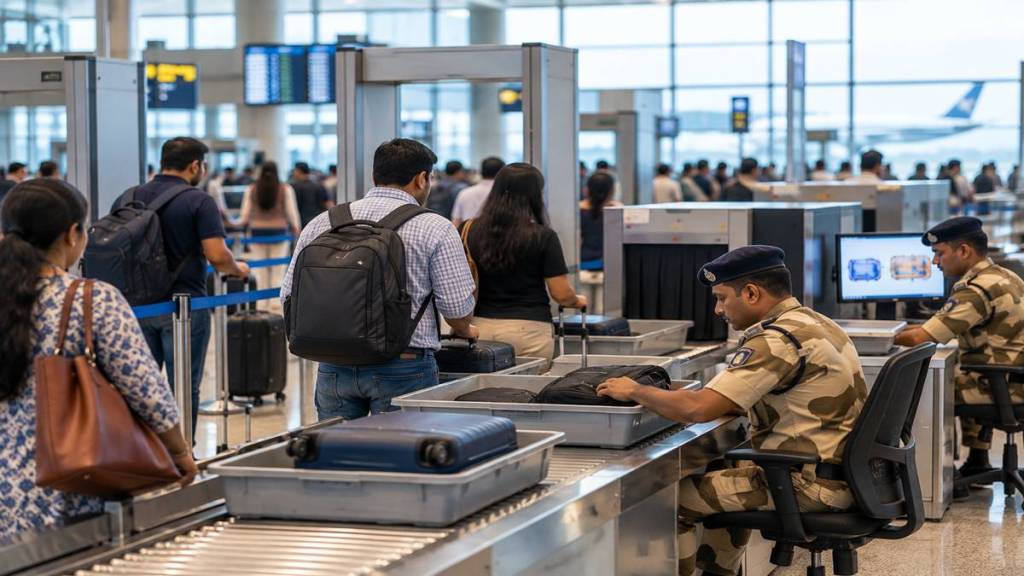

Air passengers could eventually witness a change in the way security screening is carried out at Indian Airports, with trials of full-body scanners currently going on at Bengaluru and Cochin airports.
The Bureau of Civil Aviation Security (BCAS) is collecting data from these trials, including details on the number of alarms generated. The findings will be assessed and the scanner’s algorithms refined before a decision is taken on their introduction at airports, PTI reported, citing BCAS Director General Rajesh Nirwan.
Nirwan stated that full-body scanners have been mandated for eight airports, although details of those airports were not immediately available. Cochin is not among the eight airports where the scanners have been mandated.
What could full-body scanners mean for passengers?
Full-body scanners aim to identify suspicious objects or items carried on a passenger’s body during airport security screening. However, the technology has not yet been deployed at airports despite being proposed a few years ago. Several issues over passenger privacy have resulted in delays.
BCAS is now studying trial data before deciding on wider introduction of the technology.
How will passenger privacy be protected?
Commenting on the privacy concerns, Nirwan said one of the issues involved the image generated during scanning. The technology is now being made “image agnostic”, meaning the screen would display a model of the person instead of the person’s actual body image.
If the scanner discovers something suspicious, it would flag the particular area on the model where the object has been detected. This approach is intended to address one of the key privacy concerns with full-body scanning technology.
What about ornaments?
BCAS is also scrutinising how the scanners react to items commonly worn by people in India. Concerns have been raised that ornaments, including a mangalsutra, could trigger alarms.
The security regulator is working with vendors and original equipment manufacturers to refine the algorithms used by the scanners.
“What we are getting today in India is based on algorithms that have been designed for foreign markets. There are certain typical things that are on the body of Indian citizens or people living in India. So, those algorithms are also being continuously refined,” Nirwan said, as quoted by PTI.
Data accumulated during the Bengaluru and Cochin trials will help BCAS make further changes to these algorithms.
Will laptops need to be removed from cabin bags?
Another airport security technology under consideration could eventually simplify the process of screening hand baggage. Nirwan said BCAS is working on technical specifications for Computed Tomography X-Ray (CTX) machines.
Once such machines are installed at airports, passengers would be able to keep electronic items inside their hand baggage during security checks. Currently, electronic devices have to be removed from cabin baggage and placed separately in trays for screening.
BCAS also working on AI-based airport security
BCAS is also exploring the use of artificial intelligence and data analytics in airport security. Nirwan said the regulator recently issued guidelines covering the use of facial recognition and AI in CCTV systems at airports.
Such systems could, among other applications, generate alerts relating to unclaimed baggage.