


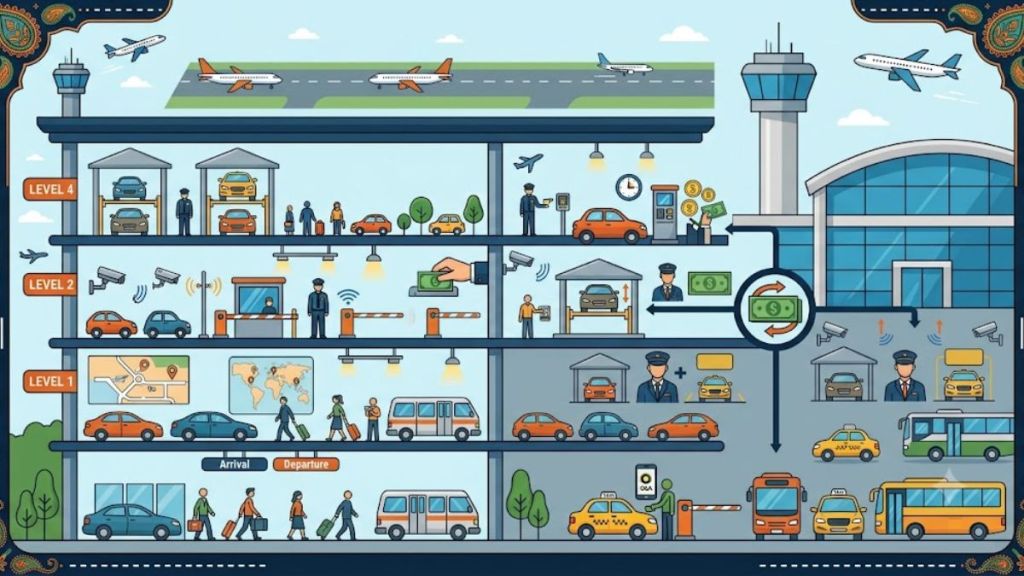

A trip to the airport does not always end with a flight. For someone driving in to receive a family member or see a friend off, it can end with a parking bill that grows as the wait stretches. Stay for a little over half an hour and the charge can already run into a few hundred rupees.
For example, at Delhi airport, private-car parking costs Rs 160 for up to 30 minutes, Rs 250 for 30 minutes to an hour and Rs 320 for one to two hours. The charge is Rs 600 for four to 24 hours. At Mumbai’s Chhatrapati Shivaji Maharaj International Airport, general parking for private cars costs Rs 230 for 30 minutes to an hour at Terminal 1 and Rs 250 at Terminal 2. Both terminals list Rs 600 for four to 24 hours.
For the person behind the wheel, that makes the length of the wait part of the travel budget. For airport operators, however, the bill covers more than the space occupied by a car. Experts say the cost stems from the cost of operating parking facilities within a highly regulated and security-sensitive airport environment, as well as the scarcity of land close to terminals.
What goes into the parking bill?
Dr. Vandana Singh, Chairperson of Aviation Cargo at the Federation of Aviation Industry in India (FAII), told financialexpress.com that airport parking involves costs that go well beyond providing a marked parking space.
“Airport parking is fundamentally different from conventional city parking because it operates within a highly regulated, security-intensive, and infrastructure-heavy environment. Airports have substantial costs related to land, terminal connectivity, security systems, surveillance, technology-enabled parking management, lighting, maintenance, manpower, and round-the-clock operations,” Singh said.
Demand adds another layer to that cost as passengers leaving their cars while they travel compete for space with people making shorter visits to pick up or see off relatives. Singh explained that proximity to the terminal is itself part of what they pay for.
“The limited availability of land close to terminals also creates a scarcity premium. Therefore, the tariff reflects not just the parking space, but the wider infrastructure and operational ecosystem supporting it,” she added.
Capt. B.V.J.K. Sharma, Chief Executive Officer (CEO) of Navi Mumbai International Airport (NMIA), told financialexpress.com that airport parking cannot be directly compared with conventional urban parking because of the infrastructure and operational demands involved.
“Airport parking should not be compared with ordinary city parking. An airport is a highly regulated, secure and operationally intensive environment. Parking facilities require significant investment in land, construction, surveillance, access-control systems, lighting, fire and safety infrastructure, traffic management and 24×7 manpower. Land adjoining a major airport also has a very high opportunity cost. At the same time, airports must manage large peaks in vehicle movement without creating congestion at terminal kerbs. Therefore, parking tariffs reflect not only the cost of a parking space, but also the infrastructure, security and service environment associated with an airport.”
How airports decide parking tariffs
Those costs help explain the bill, but they do not produce a uniform rate across airports. Airport parking rates are influenced by a combination of operating costs, passenger demand, available space and the commercial structure under which the facility is managed. The tariff can also vary depending on how long a vehicle remains parked and whether the airport is targeting short-stay, long-stay or premium users.
Even within the same terminal, the choice of parking area can make a substantial difference. At Mumbai’s T2, the published private-car tariff for four to 24 hours is Rs 900 in premium parking, compared with Rs 600 in general parking.
Singh said parking is generally treated as a non-aeronautical service, meaning pricing is guided largely by commercial considerations rather than the same regulatory framework used for aeronautical charges.
“Parking tariffs are typically determined based on factors such as airport category, passenger traffic, land and infrastructure costs, operating expenses, competitive benchmarks, and the commercial terms of the parking concession. Unlike aeronautical charges, vehicle parking is generally treated as a non-aeronautical service, with tariffs determined by airport operators and concessionaires based on commercial considerations. The revenue split therefore varies significantly by airport and contract. Where parking is outsourced, the airport may receive a fixed licence fee, minimum guarantee, revenue share or a combination of these, while the concessionaire bears operating and technology costs.”
Sharma said there is no single pricing formula across airports and that tariffs can also be used to manage limited capacity around busy terminals. “Parking tariffs also have an important operational purpose: encouraging quick pick-up and drop-off and ensuring that limited parking capacity is efficiently utilised rather than unnecessarily occupied for long periods,” he added.
A bigger business beyond higher tariffs
The same parking space that represents an expense for a traveller is a commercial asset for an airport. As passenger numbers rise and airports expand their commercial offerings, parking is emerging as a potentially important source of non-aeronautical revenue. Experts, however, say higher tariffs are not necessarily the only route to increasing earnings. Better utilisation, premium services and technology could provide additional opportunities.
Singh said airports could expand the business through a wider range of parking-related services rather than simply charging more for existing facilities.
“Yes, airport parking has the potential to become an increasingly meaningful component of non-aeronautical revenue, particularly as passenger volumes grow and airports develop more sophisticated commercial ecosystems. Parking is attractive because it generates recurring revenue from both short-stay and long-stay users, while technology can improve occupancy, payment collection, and space utilisation. However, premium pricing has to be balanced against passenger convenience and affordability. The larger opportunity is likely to come from differentiated services – premium parking, valet parking, EV charging, reserved spaces, and digital booking rather than simply increasing tariffs. AERA data already demonstrates that car parking is explicitly accounted for within airport non-aeronautical revenue.”
Sharma also pointed to parking as an important commercial activity, but said future growth would be driven by convenience and service offerings.
“Parking is certainly an important non-aeronautical revenue stream, particularly as passenger volumes increase, but I would not view the future simply as charging passengers more. The opportunity lies in offering greater choice and convenience—economy and long-stay parking, premium parking, valet services, advance digital booking, automated entry and exit, and EV charging. Airports can also integrate parking with taxis, public transport and other ground-mobility options. The objective should be to optimise the asset while keeping passenger convenience and affordability at the centre. A well-managed parking business should create value through better service and utilisation, rather than merely through higher tariffs.”
For airport operators, the challenge is therefore to balance revenue generation with passenger convenience. While land scarcity, security requirements and operating costs can make airport parking inherently expensive, experts say technology, differentiated services and better utilisation could determine how the business evolves as India’s airport network and passenger traffic expand.