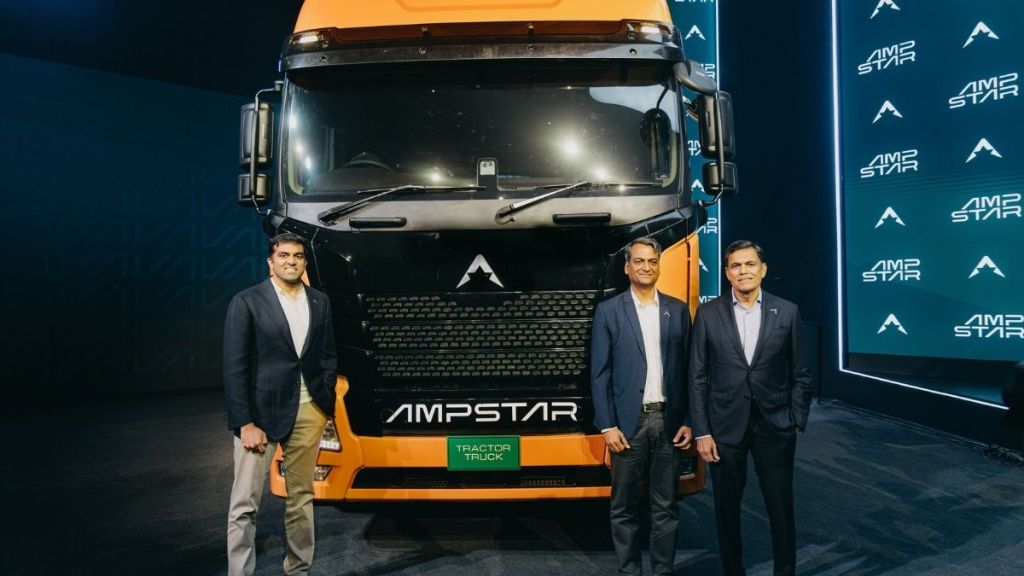
JSW Greentech has launched Ampstar, its electric commercial vehicle brand, marking the JSW Group’s foray into India’s electric truck and bus market with a ₹2,500 crore first-phase investment. Its 90-acre greenfield plant at Chhatrapati Sambhajinagar, Maharashtra, will have an annual capacity of 15,000 vehicles, comprising 10,000 electric buses and 5,000 electric trucks.
At the launch event in Mumbai on Tuesday, the company showcased a 55-tonne electric tractor-trailer and 12 meter electric bus. Commercial production is expected to begin within the next 30 days, subject to final approvals, with around 2,000 vehicles targeted for delivery over the next six months. Buses and trucks are expected to account for roughly equal volumes.
As far as trucks go, Ampstar will initially focus on 55-tonne tractor-trailers for applications across steel, cement, mining, ports and infrastructure. The trucks will be offered with fixed and swappable battery architectures, with battery configurations tailored to operating requirements.
“Our’s is not an off-the-shelf product. It is customised,” said Sumit Mittal, CEO, JSW Greentech. “Depending on the features and the application, the prices will vary.”
JSW’s steel, cement and port businesses operate around 17,000 trucks, of which around 10,000 could potentially be replaced with electric vehicles, according to Mittal. The company is starting with heavy commercial vehicles to establish its engineering capabilities before moving into lower segments. It currently has 6×4 and 4×2 variants of the 55-tonne tractor-trailer, with both fixed-charging and battery-swapping options.
The company is using LFP battery technology and multiple global suppliers for its commercial vehicles. Apart from batteries and magnets, most components, including motors, are localised. The Chhatrapati Sambhajinagar plant will manufacture truck cabins, build electric-bus bodies and assemble battery packs, with cells initially imported.
“The idea is to be an all-in partner because these are customers who are ready to take the bold call of moving from diesel to electric,” Mittal said.
JSW Group chairman Sajjan Jindal said the company aims to accelerate India’s transition to electric commercial mobility.
“Why are we getting into this business of trucks and buses? It is not our core business. Neither do we have core competence in this business,” Jindal said. “The primary idea was to be a catalyst in changing the way India moves.”
The company will initially follow a direct business-to-business model, offering outright purchase, cost-per-kilometre and wet-lease models, alongside financing, charging, maintenance and battery-as-a-service. It also plans to engage more actively with third-party customers.
Separately, JSW is planning to enter the passenger vehicle segment with its own brand around December this year.