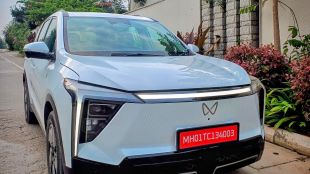
There is a new king in India’s electric vehicle (EV) landscape. Sales data for the first nine months of the calendar year shows that Mahindra’s flagship family electric SUV, the XEV 9S, has surpassed the MG Windsor EV to become India’s largest-selling single EV model.
With 31,442 units sold between January and September, the XEV 9S has sped past the Windsor EV, which recorded 30,744 units during the same period. Given their monthly trajectories, the XEV 9S is set to emerge as India’s highest-selling EV for CY26.
Both these EVs have a contrasting growth trajectory. Since its debut in January with 612 units, the XEV 9S has posted month-on-month gains, posting 4,018 units in June, and peaking at 4,636 units in September. In contrast, the Windsor EV, which peaked in July at 4,659 units, has seen sales tapering to 3,705 in August and 3,300 units in September. This slowdown suggests that product fatigue is setting in for MG’s crossover, which was CY25’s largest-selling EV at 46,373 units.
MG recently launched the Windsor Indulge Edition featuring cosmetic enhancements, but styling tweaks are unlikely to bridge the widening gap. Restoring the Windsor’s top ranking will require a major facelift or powertrain upgrades.
Crucially, the rise of the XEV 9S has not come at the expense of Mahindra’s stablemates. The closely priced five-seater XEV 9e has held a steady sales pattern, logging 16,918 units during January-September 2026 (averaging 1,880 units a month).
Speaking on Mahindra’s multi-seater approach, Pratap Bose, chief design and creative officer (auto & farms), Mahindra, had noted that while the five-seater XEV 9e drew buyers to showrooms, larger joint families needed a dedicated six- and seven-seater solution. That design pivot has paid off, as the XEV 9S tapped into that unaddressed family demand without diluting XEV 9e sales.
The sales numbers also validate the analysis of Gaurav Vangaal, associate director, LVP forecasting, Mobility Global, who recently highlighted that the XEV 9S brought in additional sales for Mahindra without cannibalising existing offerings.
But most importantly, the XEV 9S has proven that mass-selling EVs need not be in the Rs 10-20 lakh segment; instead, they need to be value-for-money models.
Priced between Rs 20.65 lakh and Rs 30.9 lakh (ex-showroom), the XEV 9S has unmatched value proposition. Offering flexible six- and seven-seat layouts across three battery packs, it addresses distinct consumer needs. In addition, Mahindra’s Battery-as-a-Service (BaaS) option lowers the entry price to just Rs 12.65 lakh, plus battery financing cost of Rs 3.75 per km.
An industry veteran added that by matching family utility with flexible ownership models, Mahindra has demonstrated that premium positioning and high volume can coexist in India’s evolving EV space. “With just three months of the year left and a rising sales trajectory, the XEV 9S is on track to finish 2026 as India’s definitive EV leader,” he said.