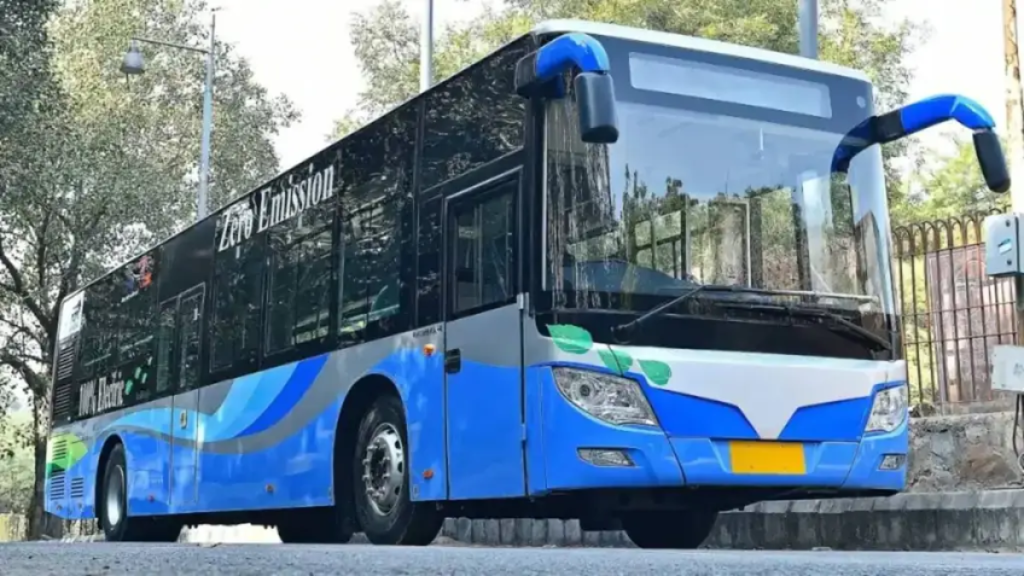
A day after cancelling the ₹1,245-crore tender for 1,225 electric buses, the Uttar Pradesh government reissued it with a new procurement preference for original equipment manufacturers (OEMs) with manufacturing facilities in the state. The revised request for proposal (RFP) allows eligible ‘UP OEMs’ to secure up to 600 buses by matching the lowest bidder’s price, potentially giving them a share of the order even if they do not emerge as the lowest bidder.
The change could give Tata Motors, Ashok Leyland and JBM Auto an advantage, as the companies have manufacturing facilities in Uttar Pradesh. The revised RFP was issued by the Directorate of Urban Transport on October 15.
The RFP explicitly states that the preference will apply only if the lowest bidder (L1) is not a ‘UP OEM’. If the L1 bidder itself qualifies as a ‘UP OEM’, it will receive 100% of the contracted quantity, with no further allocation under the preference mechanism.
The earlier tender, issued in June, did not include this state-specific preference.
Tata Motors, Ashok Leyland and JBM Auto have faced stiff competition in recent large electric-bus tenders, where competitors such as JSW, EKA Mobility, PMI Electro, Olectra Greentech and VE Commercial Vehicles, along with newer entrants and consortiums including Sai Green Projects and Transvolt, have secured orders. None of these competitors has a manufacturing plant in Uttar Pradesh.
Industry executives said the clause could alter the competitive dynamics of the tender, warning that it may weaken price competition and push up procurement costs for the state. They argued that bidders may be less inclined to offer aggressive discounts if they expect the order to be split even after another company quotes the lowest price, potentially undermining price discovery.
A query sent to the Directorate of Urban Transport and the Uttar Pradesh chief minister’s office seeking the rationale for the change did not elicit a response.
A sector expert cautioned that the policy could prompt other states to introduce similar location-based preferences under pressure from local manufacturers, potentially triggering legal disputes and complicating the expansion of electric public transport.
“While this may encourage investment in UP, it could create challenges in other states as they may follow its precedent and introduce location-based preferences in future tenders. This could lead to inefficiencies in mass manufacturing, ultimately affecting OEMs’ profitability and hampering the electrification of the public transport sector,” said Puneet Gupta, director, Mobility Global.
An OEM executive warned that the move could prompt other states to reserve entire tenders for state-based OEMs, eventually leading to similar demands at the city level.
Another industry executive argued that such a policy would do little to improve value addition within the state, as a significant share of value addition in automobile manufacturing takes place at the component level. Instead, the executive said, the preference could discourage OEMs from participating in the tender.
While procurement rules prescribe domestic manufacturing or value-addition requirements, an explicit preference linked to the location of manufacturing facilities within a particular state marks a departure from the approach seen in previous central and state government tenders.
The Uttar Pradesh government’s RFP also does not quantify the expected gains in local employment, investment or manufacturing capacity that would justify the potential trade-offs for competition.
The tender covers 725 nine-metre air-conditioned buses and 500 twelve-metre buses, with estimated project costs of ₹660 crore and ₹585 crore, respectively. It follows the gross cost contract model, with a concession period of 12 years.
Bids are due by November 26, with technical bids scheduled to open on November 27.