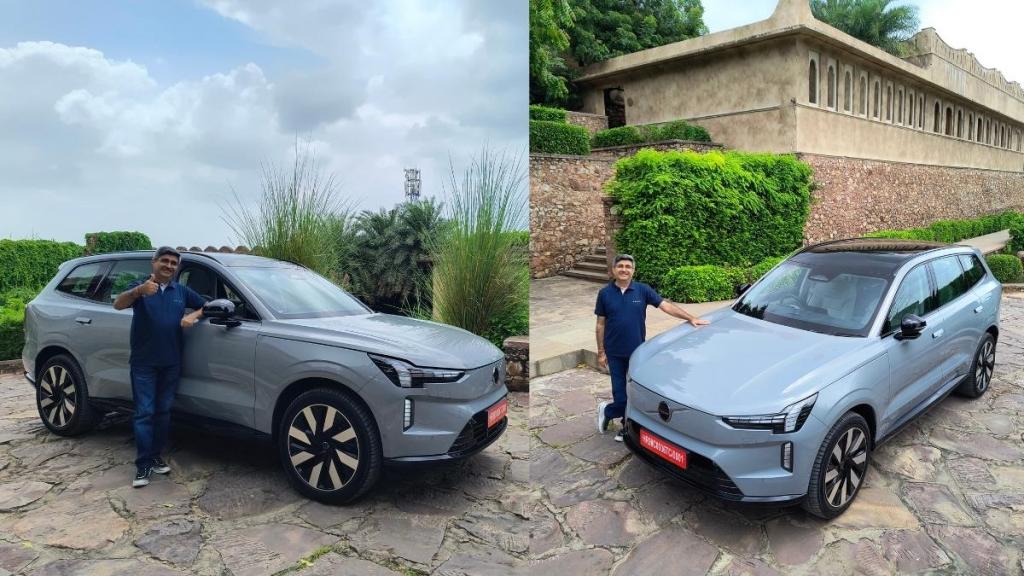
The whisper-quiet cabin of the three-tonne Volvo EX90 glides along the open tarmac, masking the potential of its 456 horsepower and 670 Nm of torque. Outside, the dust of rural Rajasthan kicks up; inside, the Scandinavian design makes the atmosphere serene. Sitting with me is Jyoti Malhotra, the managing director of Volvo Cars India. On an open stretch, the EX90 hits 100 km/h in just 5.5 seconds, the air suspension absorbs the broken patches of the road, and the all-wheel drive (AWD) keeps the wheels in check.
To be launched on October 12, the EX90 is expected to be expensive – in the Rs 1 crore range, or more – and I ask if a rear-wheel-drive variant might appeal to Indian buyers looking for a lower entry price. He shakes his head. “AWD is essential at this level, delivering the superior performance, traction, and inherent safety that define a Volvo flagship. We want every EX90 customer to experience the absolute pinnacle of our technology,” he says. “Moreover, our experience shows that buyers in the top-tier segment prefer uncompromised luxury and performance.”
As the EX90 silently eats up kilometres, the drive mode and power delivery are managed through the massive 14.5-inch central touchscreen—a display that houses almost every function, from the climate control to opening the glovebox. While the button-free dashboard looks clean, adjusting the ORVMs or switching settings while negotiating rural roads requires taking your eyes off the road.
As we slow down in rural India’s high-decibel hustle and bustle, the 1,610-watt, 25-speaker Bowers & Wilkins system softly fills the insulated cabin. The real-world range indicator promises more than 500 km range at 95% charge with the four-zone climate control on. But as Rajasthan’s harsh sunlight hits the panoramic electrochromic glass roof, I ask a pragmatic question: “For chauffeur-driven owners sitting in the back: where are the rear sunshades and seat ventilation? And will the pale ‘Dawn’ interior hold up against the fine, persistent dust of rural India?”
“The Dawn interior captures Scandinavian luxury while remaining highly practical,” Malhotra counters, pointing out the electrochromic glass that filters out heat and UV rays. “The 6-seater configuration maximises comfort. As far as future updates are concerned, we are a customer-centric brand, and as we deliver the EX90 to Indian roads, we will actively listen to user feedback.”
The conversation turns to the broader landscape, where overall luxury car sales in India linger below 2% of the market—a stark contrast to China’s more than 10%. High import duties and taxes make buying a luxury car in India significantly pricier than in Western markets.
But Malhotra sees a shift, powered by electrification. “The penetration of EVs within our portfolio is growing well,” he says. “Today, one in four cars we sell is an EV. The mindset is shifting from ‘should I buy an EV’ to ‘which EV should I buy’.”
To capitalise on this momentum, Volvo is doubling down. On October 12, the Swedish automaker will also launch the top-end ES90 sedan, which will be locally assembled at their plant near Bengaluru, just like the EX90.
As the EX90 glides to a halt at our destination, it becomes clear that Volvo isn’t interested in playing a volume game with scaled-down models, but is betting that India’s top-tier buyers want uncompromising safety and pure electric luxury—wrapped in a package that moves across highways and country roads alike with quiet, effortless authority.