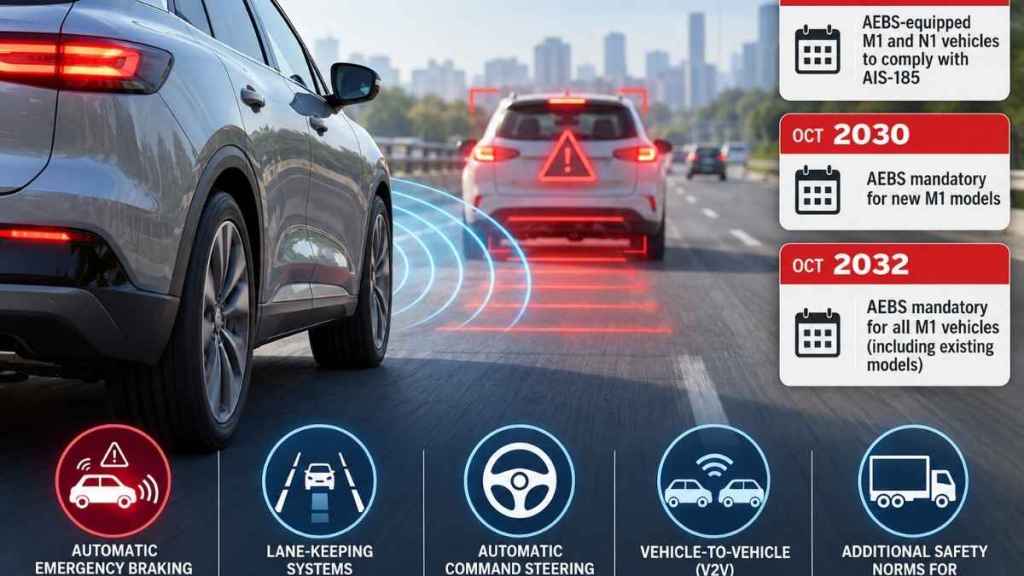
The Ministry of Road Transport and Highways (MoRTH) has proposed making Advanced Emergency Braking Systems (AEBS) mandatory for all passenger vehicles from October 1, 2032, under draft amendments to the Central Motor Vehicles Rules, 1989.
The proposal envisages phased implementation, with the system becoming mandatory for newly manufactured models from October 1, 2030, before being extended to all M1 category vehicles, including existing models, two years later. The M1 category covers passenger vehicles with up to eight seats, excluding the driver.
The draft notification has been opened for public consultation for 30 days, during which the ministry will invite objections and suggestions before finalising the rules.
AEBS is an Advanced Driver Assistance System (ADAS) feature that automatically applies the brakes when a driver fails to respond to an impending collision. The technology is designed to prevent an impact or reduce its severity.
Under the proposed timeline, from October 1, 2028, M1 passenger vehicles and N1 light goods vehicles fitted with AEBS will have to comply with Automotive Industry Standard AIS-185. The N1 category covers goods vehicles with a gross vehicle weight of up to 3.5 tonnes.
Steering and lane-keeping systems
The draft also proposes standards for steering and lane-keeping technologies. From October 1, 2027, steering effort in motor vehicles will have to comply with AIS-193. Motorcycles, invalid carriages and three-wheelers without a steering wheel are proposed to be exempt.
M1 vehicles equipped with Automatic Command Steering Functionalities (ACSF) will also have to meet AIS-193, while those fitted with an Emergency Lane Keeping System (ELKS) will need to comply with AIS-191 (Part 1).
The ministry has proposed making ACSF and ELKS mandatory for M1 vehicles registered as transport vehicles from October 1, 2029. The measures are expected to affect taxis in particular, with drowsiness detection and attention-warning systems also proposed for these vehicles.
Commercial vehicle safety
The proposals complement other safety measures for commercial vehicles. New truck and bus models are set to receive AEBS from January 2027, alongside systems such as blind-spot information, moving-off information, driver-drowsiness detection and lane-departure warning.
A revised braking standard for trucks is due to take effect from October 1, 2027, alongside electronic stability control (ESC), which is designed to improve vehicle stability, including during braking on curves.
MoRTH has also proposed mandating Vehicle-to-Vehicle (V2V) communication in all newly manufactured vehicles from October 1, 2028. The technology enables vehicles to exchange information such as speed, position and direction, complementing ADAS features such as AEBS.
The proposals form part of the government’s broader effort to improve road safety and reduce accidents and fatalities. The requirements remain subject to public consultation and final notification.