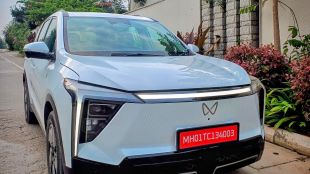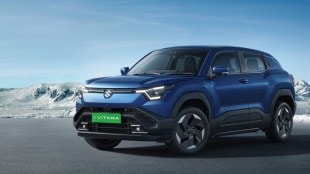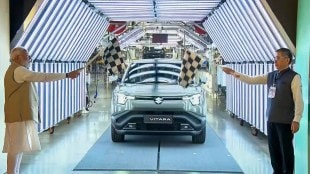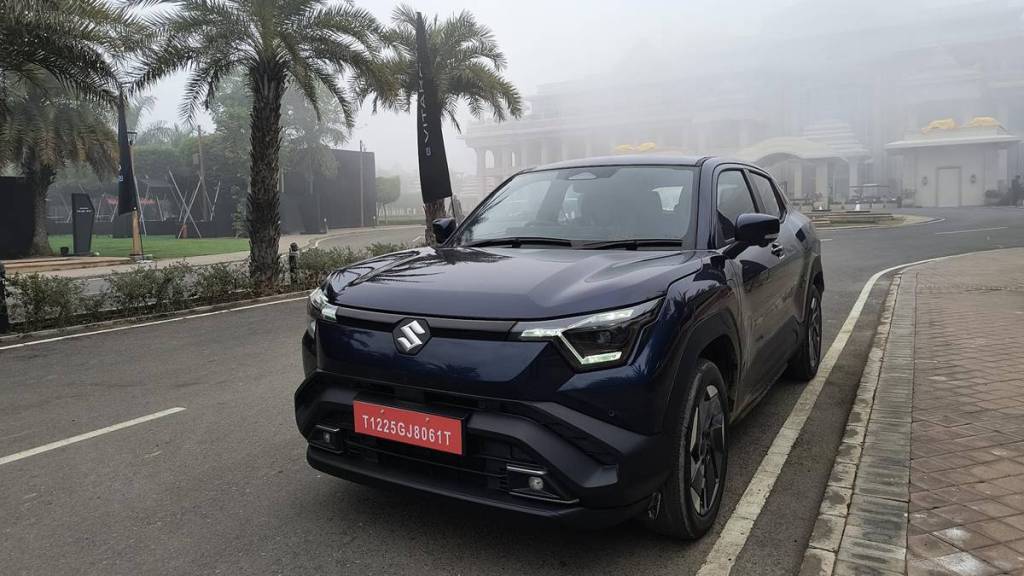
While Maruti Suzuki’s domestic market share continues to hover around 40% despite new launches, the carmaker — driven by its all-electric flagship, the eVitara — has quietly emerged as an electric vehicle (EV) export powerhouse, operating as a global production hub for its parent company, Suzuki Motor Corporation (SMC).
Sales data sourced from the industry for Q1FY27 (April-June 2026) reveals that Maruti Suzuki commanded an astonishing 97% market share in EV exports from India, shipping 15,210 units of the eVitara overseas. This builds on the FY26 performance, during which Maruti Suzuki captured nearly 90% of all Indian EV exports with 25,549 units.
eVitara exports cross 46,000 units
Since the time overseas dispatches of the eVitara began in August 2025 — six months before its Indian launch in February — Maruti Suzuki has cumulatively exported over 46,000 units to more than 49 countries. These shipments are heading to mature, highly regulated markets such as Japan and Western European nations, where quality benchmarks are stringent but the Suzuki brand value is strong.
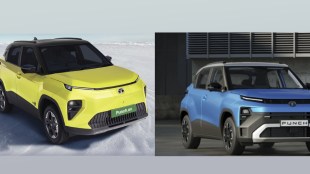
The performance is in stark contrast to domestic EV leaders Tata Motors and Mahindra, whose electric offerings have struggled to find traction abroad. In FY26, Tata Motors exported just 2,518 EVs — primarily to developing markets like South Africa, Nepal, Bhutan, and Mauritius — and Mahindra exported merely 275 electric units.
This EV export surge is part of a broader passenger vehicle (PV) export footprint. In Q1FY27, Maruti Suzuki exported 123,330 PVs, holding 55.5% market share of total Indian PV exports — the carmaker shipped more PVs abroad than all 16 other domestic carmakers combined.
In addition, six of the top eight exported PV models from India in Q1FY27 belonged to Maruti Suzuki, led by the Fronx (23,803 units), the Jimny (21,840 units), and the eVitara (15,210 units), which ranked as India’s third highest-exported car model overall.
“What we are seeing is a strategic division of labour,” noted a senior auto analyst tracking global supply chains. “While the domestic market has become a cut-throat competitive arena, SMC is leveraging India’s cost structure to build a high-margin export factory, and today India is the sole global manufacturing hub for models like the eVitara and the 5-door Jimny.”
Piyush Goyal praises Maruti’s export push
Maruti Suzuki’s export performance also drew praise from the government at the 66th SIAM Annual Convention where the Union Minister for Commerce and Industry Piyush Goyal lauded the carmaker for driving India’s automotive exports and urged the rest of the domestic industry to follow suit.
“The only statistic that I can recognise and appreciate is the million cars that you exported last year,” Goyal told industry leaders at the convention. “Maruti is today exporting probably half of those, and is now exporting electric cars, even supplying to Japan. If we do what Maruti has started doing, I would urge all of you to look at export markets more actively and aim to double exports every two years.”
With the India-UK Free Trade Agreement in effect and an EU trade deal on the horizon, Maruti Suzuki’s early-mover advantage in high-standard EV exports positions it to lead India’s next phase of global automotive manufacturing.