India is on the cusp of one of the world’s largest vehicle retirement programmes. By 2030, the country is expected to have around 22 million end-of-life vehicles (ELVs), generating nearly 7 million tonne of automotive scrap every year, according to the Council on Energy, Environment and Water (CEEW). At the same time, India adds more than 20 million new vehicles annually, making it the world’s third-largest automobile market. How those ageing vehicles leave the road will increasingly shape not only urban air quality but also the country’s ambitions to build a circular economy.
The government has spent the past five years putting the pieces in place. Since announcing the Vehicle Scrappage Policy in 2021, it has licensed Registered Vehicle Scrapping Facilities (RVSFs), introduced digital certificates of deposit to encourage owners to scrap old vehicles, and, through the End-of-Life Vehicles Rules, 2025, brought automobile manufacturers under Extended Producer Responsibility (EPR), making them responsible for environmentally sound recycling.
Yet the system remains in its infancy. According to NITI Aayog, fewer than 3% of India’s estimated end-of-life vehicles entered authorised scrapping facilities between August 2022 and July 2025. Many continue to be resold in states with less stringent enforcement, while others are dismantled by the country’s extensive informal recycling sector.
Even so, the government says the policy is beginning to show results. Earlier this year, Union Road Transport and Highways Minister Nitin Gadkari said 394,000 vehicles had been scrapped by December 2025, including 165,000 government-owned and 239,000 private vehicles. The programme, he said, has attracted Rs 27 billion in private investment, recovered 3.76 lakh tonne of scrap steel, raised India’s reuse of raw materials to 33%, and reduced carbon dioxide emissions by an estimated 6,353 kilotonne, equivalent to planting about 260 million trees.
The environmental case appears straightforward. Older vehicles emit significantly more pollution than modern ones, while the steel, aluminium, copper and precious metals locked inside them can be recovered and reused instead of being mined again.
But researchers say there is another side to the equation. Every vehicle that enters a scrapyard has to be dismantled, processed and replaced. That consumes energy, creates emissions and requires a new vehicle to be manufactured. The environmental question, therefore, is not simply whether an old vehicle should be scrapped but whether replacing it leaves a smaller overall footprint than continuing to use it.
“The environmental impact should not be measured by comparing an old vehicle with a scrapped vehicle,” says Professor Santosh Kumar Sahu of IIT Madras. “The appropriate comparison is between continuing to use the existing vehicle and retiring it while manufacturing a replacement. Only a full life-cycle assessment can determine which option is environmentally preferable.”
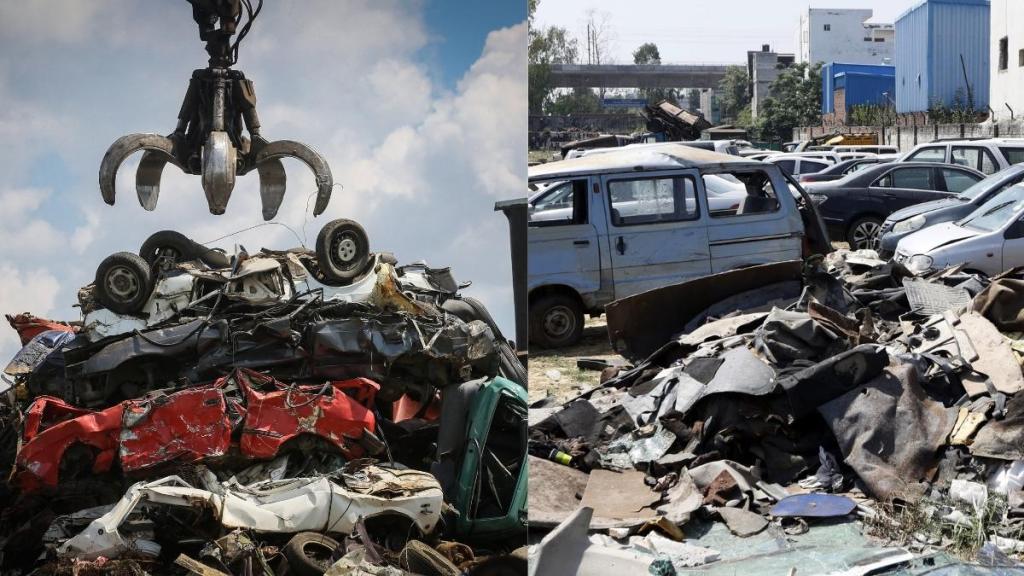
A modern scrapyard is a long way from the image of a rusting car being crushed into a cube of metal. Before dismantling begins, fuel, engine oil, coolant, brake fluid and refrigerants are removed. Batteries, tyres, glass, airbags and electronic components are separated. The remaining shell is then shredded so that steel, aluminium and copper can be recovered and sent back into manufacturing.
That process has an environmental cost. According to Sahu, processing an end-of-life vehicle typically consumes 500-2,000 megajoules of energy and emits 50-200 kg of carbon dioxide equivalent, depending on the technology used and the electricity powering the recycling facility. Yet it also prevents emissions elsewhere.
According to Professor Sebastian Morris, Chair at the Centre for Public Policy and Governance, an average passenger vehicle contains 700-900 kg of steel, 50-120 kg of aluminium and 10-20 kg of copper. Recovering these materials instead of producing them from virgin ores can avoid roughly 1 tonne of carbon dioxide equivalent for every vehicle recycled.
No universal answer
A heavily used diesel truck that travels thousands of kilometres every month accumulates emissions quickly. Replacing it with a cleaner model can offset the carbon emitted during manufacturing within a relatively short period. A well-maintained hatchback driven only a few thousand kilometres a year presents a different calculation. The emissions saved during its remaining life may not always outweigh the environmental cost of building another vehicle.
“There is no universal answer,” says Sahu of IIT Madras. “Replacing an older internal combustion engine vehicle with a newer model generally delivers environmental benefits once operational savings offset the emissions from manufacturing the replacement. That break-even period usually occurs within two to eight years, or roughly 30,000 to 100,000 km, depending on annual mileage, vehicle type and the local energy mix.”
That distinction lies at the heart of an emerging debate over India’s scrappage policy. The programme largely uses vehicle age as the trigger for retirement. Private vehicles are required to undergo fitness tests after 20 years and commercial vehicles after 15. In Delhi, separate judicial orders effectively remove diesel vehicles older than 10 years and petrol vehicles older than 15 years from the road.
“The underlying problem is that age is not always a reliable proxy for emissions,” says Arunesh Karkun, research lead at Sustainable Futures Collaborative. “Remote sensing by ICCT in Delhi and Gurugram found light goods vehicles emitting up to 14 times their laboratory NOx limits and taxis four times, so how a vehicle is used and maintained can matter more than when it was registered. An age-based rule will scrap some clean vehicles and miss some dirty ones. For high-emitting vehicles, whether or not they cross the age threshold, the case for replacement is strong.”
That view is echoed in the recent study, Rethinking India’s Vehicle Scrappage Policy, by Gaurav Gupta of the Centre for Energy Regulation and Prof Anoop Singh of IIT Kanpur. Using an India-specific lifecycle analysis, the researchers argue that accelerating replacement purely because a vehicle has crossed an age threshold can, under certain conditions, increase cumulative energy demand and greenhouse gas emissions. Manufacturing a replacement vehicle requires new steel, aluminium, plastics and other materials whose environmental costs may not always be recovered if the vehicle was lightly used.
The authors argue that a more performance-based and lifecycle-aware approach would be more effective than relying predominantly on age, particularly because a relatively small proportion of poorly maintained vehicles account for a disproportionate share of emissions.
That distinction also helps explain why experts separate air pollution from climate change. For cities struggling with poor air quality, replacing older commercial vehicles is widely regarded as one of the fastest ways to reduce harmful pollutants.
“End-of-life vehicles are estimated, based on the latest emission factors, to emit particulate matter (PM) at levels many times higher than a BS-VI-compliant vehicle. They also present a resource recovery opportunity,” says Dr Himani Jain, fellow at CEEW. “CEEW estimates scrap availability from the automotive sector is expected to reach nearly 7 million tonne per annum by 2030. Against this backdrop, the Government of India proposed a new scheme to replace old trucks and buses in Delhi-NCR, which could help retire over 200,000 highly polluting vehicles.”
Cleaner air, however, does not automatically mean lower carbon emissions. “Not always, and it depends on which pollutant you mean,” says Karkun. “For local air pollutants like NOx, PM and CO, the benefit of removing highly polluting vehicles is real and immediate. The manufacturing happens somewhere else, while the tailpipe benefit is felt on city streets.
“For carbon it is a real trade-off. Manufacturing emissions are recovered only through use, so payback depends on mileage. A lightly used car may not repay its replacement within its remaining life whereas a high-mileage commercial vehicle does so quickly. Where the replacement is electric, the grid and the battery make the picture more complex, even though the local air quality benefit is immediate.”
That is perhaps the biggest misconception surrounding scrappage. The question is not whether scrapping produces emissions, it does. Nor is it whether older vehicles pollute more as many clearly do. The question is which vehicles produce the greatest environmental benefit when they are replaced.
That debate, however, often gives way to a far simpler consideration for vehicle owners, that is, money. And that may be the biggest reason India’s formal scrappage ecosystem has struggled to attract vehicles.
The money factor
For most owners, the decision is driven less by emissions than by money. A functioning vehicle almost always commands a higher price in the resale market than at an authorised scrapping facility.
That is one reason India’s formal scrappage ecosystem remains small. “The reason is economics, as owners reported being offered double the value from informal buyers in comparison to formal scrapping centres,” says Karkun of Sustainable Futures Collaborative. “Recovery isn’t the main case for scrappage in India. We already recover most of the metal through an informal sector that unfortunately does it without depollution, refrigerant capture or fluid containment. The formal sector can help make this both a cleaner and more efficient process.”
The informal sector has long been India’s de facto recycling industry. It recovers engines, gearboxes, steel, aluminium and spare parts with remarkable efficiency. What it often lacks are systems to safely remove hazardous materials before dismantling. Engine oil, brake fluid, coolant, refrigerants and batteries can contaminate soil and groundwater if not handled properly, while plastics, foams and automotive shredder residue often end up in landfills or are disposed of without treatment.
Recognising this, the government has encouraged investment in authorised Registered Vehicle Scrapping Facilities (RVSFs), where every vehicle is depolluted before dismantling and materials are recovered under controlled conditions.
Among the largest players is Tata Motors, which now operates 11 RE.WI.RE (Recycle With Respect) facilities across the country with an annual capacity of around 190,000 vehicles. “The Vehicle Scrappage Policy has played a significant role in creating awareness about responsible end-of-life vehicle disposal and the benefits of transitioning to newer, safer and cleaner vehicles,” a Tata Motors spokesperson says.
But even as formal infrastructure expands, consumer behaviour continues to favour resale. According to Cars24, owners are increasingly replacing vehicles earlier, not necessarily to scrap them but to preserve their resale value.
“Consumers are increasingly planning their replacement decisions earlier. Rather than waiting until the vehicle reaches the end of its life, owners are selling sooner to preserve resale value and avoid regulatory uncertainty,” says Shivanshu Makkar, chief financial officer (India), Cars24.
The demand is largely coming from beyond India’s biggest cities. Cars24 says 62% of demand on its platform now comes from Tier-II and Tier-III cities, where older vehicles continue to find buyers despite tightening restrictions elsewhere.
Spinny has also reported a similar trend. “Many owners still compare the value of scrappage incentives with alternatives such as selling the vehicle in Tier-3 and Tier-4 markets or renewing its fitness certificate,” says Niraj Singh, founder and chief executive officer of Spinny.
That creates a paradox. An ageing diesel vehicle removed from Delhi’s roads may improve the capital’s air quality. But if it is sold and continues operating elsewhere, the environmental gains are diluted.
“Scrapping only counts if the vehicle is destroyed rather than moved across a state boundary,” says Karkun. “Otherwise, the problem is simply relocated.”
NITI Aayog has identified inadequate financial incentives, limited public awareness, insufficient testing and scrappage infrastructure, and weak enforcement as the principal reasons for the low adoption of authorised scrappage. It has also argued that bringing the informal sector into the formal ecosystem, rather than trying to replace it entirely, could improve recovery rates while ensuring environmentally safer recycling practices.
The greener choice
India is not the first country to confront the environmental challenge of retiring millions of ageing vehicles. But as vehicle ownership continues to rise, many countries are shifting their focus from simply scrapping cars to designing a circular economy around them.
The European Union requires that 85% of every vehicle by weight be recycled and 95% recovered. In June, it adopted the Vehicle Circularity Regulation, which introduces recycled-content requirements and encourages manufacturers to design vehicles that are easier to dismantle and recycle. Japan has taken a different route, financing recycling through a fee collected when a vehicle is purchased rather than when it is scrapped, ensuring funds are available to recover materials that are expensive but environmentally important.
For Arunesh Karkun, these examples highlight an important lesson for India. “I’m not going to name a single best system, but Japan and the Netherlands are the usual references, and both fund recycling through a fee collected when the vehicle is bought rather than an incentive paid when it is replaced. That works better because it pays for the unprofitable end of the process. Japan is now moving further, paying dismantlers for the plastic, glass and aluminium they recover. The EU adopted a new Vehicle Circularity Regulation in June 2026 with recycled-content requirements and design-for-dismantling rules.”
He believes India could adapt some of these ideas rather than replicate them outright. “For India that points to collecting a recycling fee at first registration rather than or alongside paying an incentive at replacement, crediting producer obligations on total material recovered, and targeting enforcement at vehicles measured to be high emitters rather than at vehicles that are simply old.”
The government has already begun moving in that direction through the End-of-Life Vehicles Rules, 2025, which brought automobile manufacturers under Extended Producer Responsibility (EPR), making them accountable for environmentally sound recycling. But experts say regulation alone will not be enough.
“Authorities should narrow the price gap between the secondary markets and formal scrappage through incentives and financing models. Enforcement of vehicle de-registration and end-of-life regulations should be strengthened. Success will depend on addressing infrastructure constraints, particularly by rapidly expanding authorised vehicle scrapping and recycling facilities in regions such as Delhi-NCR, where large-scale fleet replacement is expected,” says Dr Himani Jain of CEEW.
The evidence gathered so far points to a more nuanced conclusion. Scrapping a vehicle does create emissions. Recycling consumes energy, while manufacturing a replacement vehicle carries a significant carbon footprint. But continuing to operate an ageing, high-emitting vehicle also comes at an environmental cost. The greener choice, as per experts, depends on the balance between those two.