TVS Motor Company has backed Delhi’s move to allow only electric two-wheelers to be registered from April 1, 2028, but its limited electric portfolio and the absence of electric motorcycles could make it challenging for the company to capture the full breadth of demand it currently serves in the capital through its ICE range.
“We are in full support, and we will follow the direction of the government,” Gaurav Gupta, President, India 2W Business at TVS Motor Company, said on Thursday.
However, when asked about bringing electric motorcycles ahead of the Delhi policy taking effect, the company declined to discuss its future product line, leaving the timing of a key addition to its EV portfolio unclear.
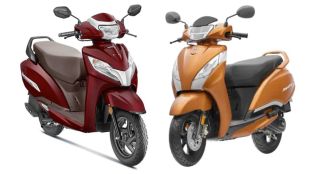
TVS currently serves its two-wheeler customers through 14 ICE products—nine motorcycles and five scooters—but has only three electric scooters in its portfolio and no electric motorcycle. The gap is particularly relevant in Delhi, where the company sold 1,50,757 two-wheelers in FY26, of which only 6,866, or 4.6%, were electric, according to Vahan data.
This means the company currently meets the bulk of its Delhi demand through its much broader ICE portfolio. With new two-wheeler registrations in the capital set to become electric-only from April 1, 2028, TVS will need to broaden its EV range if it is to retain customers across the segments it currently serves.
The challenge extends beyond Delhi. Motorcycles accounted for around 60% of India’s 1.98 crore two-wheeler sales in FY26, making the absence of an electric motorcycle a significant gap for a company whose own motorcycle business remains central to its portfolio. TVS sold 27.13 lakh motorcycles in FY26, compared with 3.71 lakh electric two-wheelers.
TVS is nevertheless preparing for faster EV adoption. Its current electric two-wheeler manufacturing capacity is around 40,000-45,000 units a month and it plans to take this beyond 50,000 units a month over the next few months. It is also evaluating a further increase in capacity in the fourth quarter, depending partly on suppliers’ ability to scale up.
Gupta said electric two-wheelers now account for around 10% of industry sales this year, compared with 6.7% last year.
“We’re expecting it to keep on growing,” he said.
While supporting the policy, TVS was cautious about whether the wider ecosystem can keep pace with the transition. Asked whether infrastructure would be ready when the mandate takes effect, Gupta said: “It’ll be difficult for me to say whether infrastructure is ready today or will it be ready by tomorrow.”
The company expects manufacturers and other stakeholders to work together to implement the government’s direction.
“All the stakeholders, I would expect like TVS, would come and help to implement the direction of the government,” Gupta said.
TVS is also evaluating alternative technology pathways to reduce supply-chain risks as EV adoption increases, particularly around critical components such as magnets and semiconductors.
“At this point in time, various combinations are being explored,” Gupta said. “It would be very difficult to say that this motor will be our go-to motor perpetually.”
At the same time, the company is pushing premiumisation, with Gupta saying buyers are increasingly opting for more feature-rich, higher-end variants within the same model category and placing greater value on technology, safety and features.