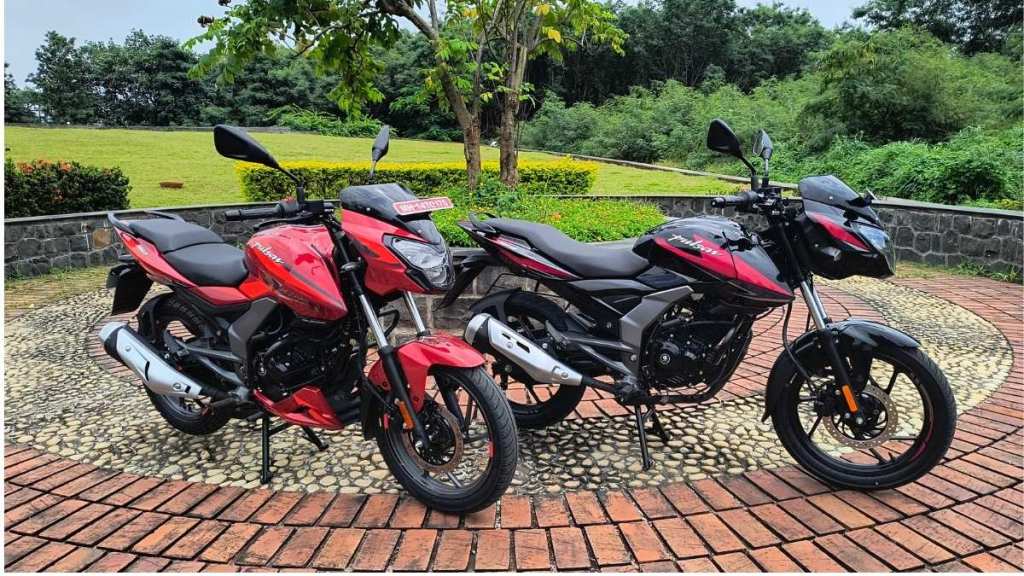
Riding through the streets of Pune on the newly launched Pulsar 150 and Pulsar 125, I was taken back to my college days in 2004. Back then, the original Pulsar line — available as a 150 and the beefier 180 — transformed the Indian sports motorcycle landscape. It became the ultimate object of desire for college kids and young riders. I owned a 2004 Pulsar 180, a motorcycle that felt well ahead of its time. I vividly recall pounding the highway from Punjab to Delhi in a brisk 10 hours, and later taking it on a long trip from Delhi to Auli and back just to learn skiing. The classic Pulsar visual DNA — that iconic cowl, muscular tank, and commanding silhouette — is what defined a generation of Indian motorcycling.
Now, Bajaj has resurrected that classic silhouette with a modern soul. Covering around 25 km on each bike in Pune, the step-up in refinement and build quality was instant. The classic design is back, but everything underneath feels modern.
Sitting on both motorcycles, the riding position is upright. Your knees and waist form a natural 90-degree angle, keeping fatigue at bay, complemented by a firm seat. Visually, both bikes maintain their classic charm while incorporating modern upgrades like an LED headlight, a sharp rear end, and a modern instrument cluster with Bluetooth connectivity. Underneath, the old double-cradle layout has been swapped for an all-new diamond tubular frame that is 20% lighter and 60% stiffer, integrated with a rear monoshock setup.
Pulsar 125: The commuter
The new Pulsar 125 is a lively urban machine. Pumping out 12.1 PS of power and 11.4 Nm of torque, it feels noticeably faster than standard 100cc commuters and punchier than most typical 125cc city bikes. It has enough top-end grunt to handle short intercity runs, and is a step-up for anyone moving up from a Hero Splendor. While the engine runs out of breath when pushed hard, its low-end usability makes city commuting effortless.
Pulsar 150: The all-rounder
Switching to the Pulsar 150 elevates the experience to familiar performance territory. Delivering 14 PS and 14.1 Nm of torque, this modern 150 engine feels as potent as my old 2004 Pulsar 180 did. With 85% of its peak torque available right from 3,000 RPM, pick-up is good. It’s a dual-purpose bike: light for daily office commutes, and powerful enough for intercity highway trips.
Braking across both models inspires great confidence. On models equipped with the Combi Brake System (CBS), pressing the foot brake automatically applies the front brake as well, pulling the bike to a balanced halt. On the single-channel ABS variants, the anti-lock setup intervenes smoothly.
Pricing & verdict
Bajaj has priced these updated icons competitively. The new Pulsar 125 starts at Rs 92,990, while the Pulsar 150 starts at Rs 1.15 lakh (ex-showroom Delhi). While my brief 25-km test ride didn’t allow me to push either bike to its absolute limit, both machines leave a good impression. They blend nostalgic styling with modern mechanical refinement, making them worthy heirs to the Pulsar legacy.