By Colonel Mukesh Pandey, VSM
The morning of a cold day in August 2026 rose bright over Hanle — a village lying southeast of Leh in Ladakh. Sunlight bathed Hanle’s high-altitude observatory, Changthang’s golden grasslands glowed under the sky, and our motorcycles idle-strained to run. Umling La waited beyond Chisumle — not merely as a motorcycling milestone, but as an unfinished conversation with my past.
Years earlier, as a mid-ranking Indian Army officer, I served in Demchok. I knew its bunkers, its bitter high-altitude winds, and its quiet nights where vigilance never slept. Now, with every change of gear, I was moving back towards that frontier — towards the same ridges, the same landscape, and the same winds I had once called home.
Beyond Hanle, the terrain turned unforgiving — loose gravel, steep gradients, and sharp switchbacks demanding constant mechanical focus. At Chisumle, hot tea and noodles offered a brief respite before the mountain truly commanded. The air thinned rapidly; the wind hardened. There was only the throttle underhand, the engine thrumming beneath, and decades of memory riding silently alongside.
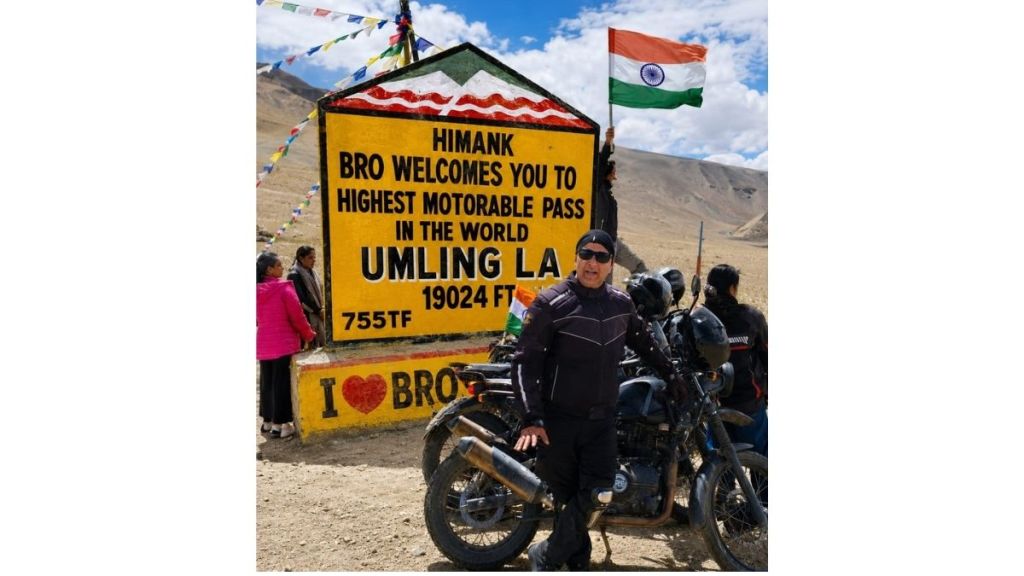
Standing at 19,024 feet, Umling La — until recently the world’s highest motorable road — rests higher than both the base camps of Mount Everest (the South Base Camp in Nepal at 17,598 feet, and the North Base Camp in Tibet at 16,900 feet). At this altitude, breathing becomes deliberate labour. Yet, upon reaching the pass, the initial instinct remains human: capture the moment before the environment forces a quick departure.
At the summit, furious winds seeped through thick gloves and balaclavas, whipping the Tricolour at what felt like thrice its normal speed. Here, the mountain does not whisper; it roars. Around the yellow Border Roads Organisation (BRO) marker, solo riders and groups gathered, seeking a moment to document their arrival. Hands trembled, breath shortened, and physical fatigue urged an immediate descent. Between fluttering prayer flags and idling engines, we waited for a few clear seconds beside the altitude marker.
Positioning the heavy machine proved an ordeal. Exhaustion weakened my balance, and machine and rider went over. Fellow motorcyclists stepped in instantly, lifting both back up. Then I caught the sight of the Tricolour against the sky. Behind lay the pass conquered; ahead lay Demchok. For a brief moment, the soldier I was and the rider I had become converged. It was more than a summit reached — it was a return to a landscape left behind years ago.
The high Himalayas, however, reserved a final test for the descent. The weather shifted rapidly, clouds gathered, and heavy rain lashed the pass for half the return journey. Water blinded visors, frigid air seeped through riding gear, and the slick road punished every misstep. Then, my motorcycle’s self-starter failed.
In that isolated stretch, with rain hammering the chassis, I called for a push-start. The response was instant. Boots slipped on wet gravel, shoulders strained, and fellow riders pushed until the engine fired back to life. That moment captured the core ethos of long-distance riding: no one crosses these passes entirely alone. When machinery or resolve falters, another rider lends their strength.
While Umling La’s record as the world’s highest motorable road was superseded by the BRO’s work at Mig La in 2025, the weight of the journey remains untouched.
You return soaked, wind-worn, and physically drained — but fundamentally shifted. At 19,024 feet, the mountain does not merely offer scenery; it returns memories you assumed time had buried. Long after the engine is turned off, the winds of the frontier continue to ride with you.
The author is a serving officer of the Indian Army